

The Village
An ancient history
La Storia
The recent studies conducted on the settlement of Borgo Cornalese allow us to redefine, with good approximation, a different history from the one that, until today, told of a supposed ancient settlement of Bulgars. Both the analysis of the masonry and the investigations conducted on archival documentation have revealed to us a complex history with ancient origins.
The buildings tell us of a millenary settlement, of fortified construction for the defense of the territory, placed on the tip of the Poirino Plateau; a first settlement has been identified, perhaps Templar, placeable in the year 1000 approximately, around which the whole fortified ricetto developed and organized itself. Traces are still detected of an ancient square tower, which almost certainly was in defense of a first ring of walls; then we find a portion of a round tower, whose ruins were subsequently used as a dovecote.
The alley of the Borgo — the ancient courtyard — lets one glimpse the fourteenth-century castle, with its beautiful masonry with pointed joints and supporting buttresses; some faint trace of frescoed plaster is still visible, of an epoch subsequent to the first construction. Coffered ceilings, vaults, cellars, and ice-houses make us take a journey into remote centuries, even though the centuries, the struggles between the lordships, and the plunderings, have left the ancient architectures deprived of every removable decoration. The history of this aggregate, unitary in appearance, but with buildings of very different typological characteristics, expresses through its masonry a millenary development, also supported by the archival correspondence. The ascertained history starts from the lineage of the Aleramo, of Salic origin, and develops between the Marquisate of Saluzzo, that of Monferrato, and that of Vasto.
The archival research in fact brings us to the court of Emperor Frederick I, who in 1163 confirms the possession of the Fief of Borgaro (one of the ancient names of Borgo Cornalese) to the Marquises of Romagnano.
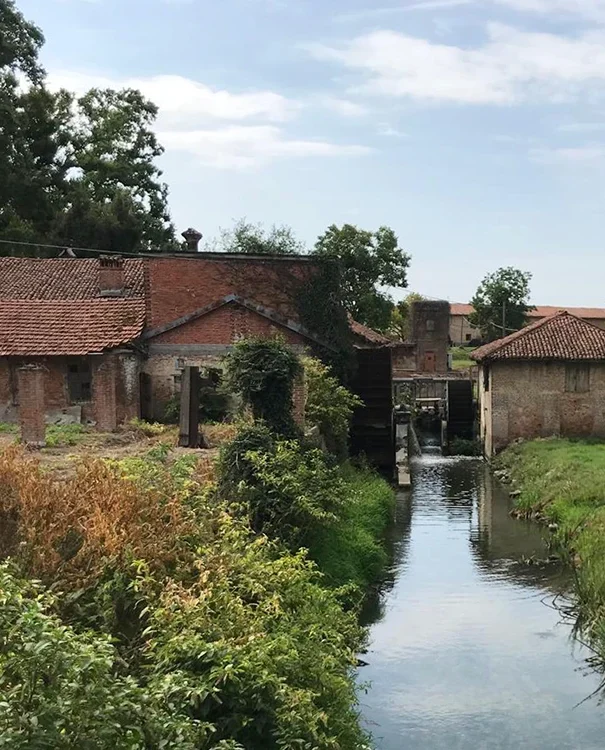
In 1224 the white monks of the Abbey of Casanova, Cistercian friars, obtain permission from Lorenzo di Borgaro to construct the canal that will become, in 1285, the Gora di Borgo, on which still today we find the mill, rebuilt in 1597.
Between 1300 and 1600, the territories of Borgo Cornalese were the scene of numerous bloody battles that made the Borgo the object of raids and destruction; traces of this can still be seen on the oldest buildings. They only hint at the presence of an upper floor beyond the current one, certainly destroyed and never rebuilt.
Borgo Cornalese maintains its strategic importance until about the middle of the 1500s, when the most important centers begin to have fortified perimeter walls, while the small defensive fiefs cease their function.
In the 1300s the Costa family settled there, treasurers of the princes D'Acaya, who remained there until the end of the 1700s. Between 1799 and 1816, the Borgo was aggregated to the territory of Villastellone.
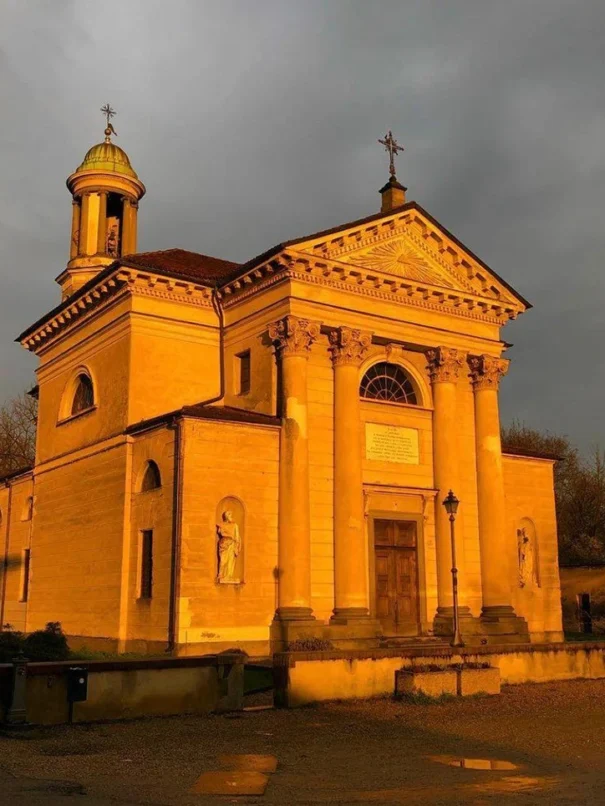
The nineteenth-century Church of the Blessed Virgin of Sorrows was built in 1850 by Duke Eugène-Alexandre Laval de Motmorency, husband of Anne-Constance de Maistre, daughter of the philosopher Joseph de Maistre. It is a building of valuable architectural craftsmanship with neoclassical lines.
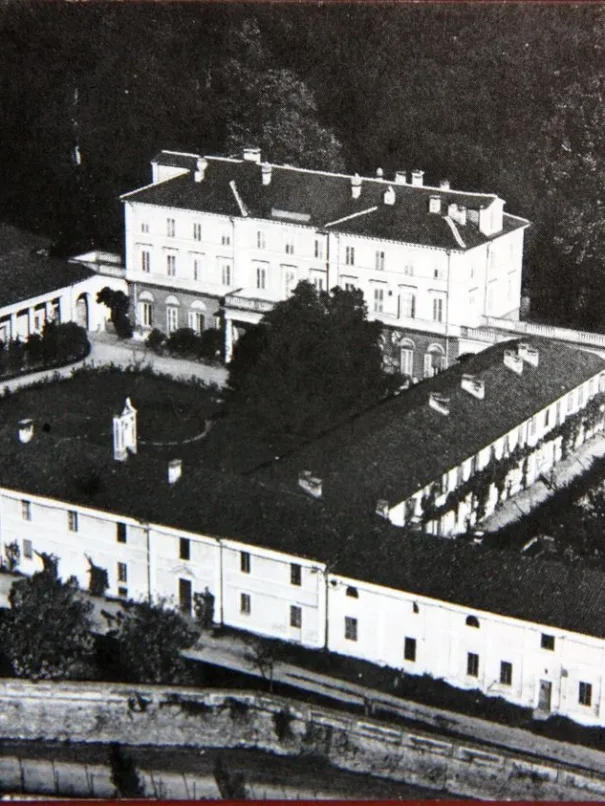
Today the settlement conserves the aspect of a self-sufficient medieval agricultural borgo, while comprising within it some buildings of more recent epoch, among which precisely the Church and the splendid Villa of the Counts de Maistre with its park.
The still-functioning water mill is set in motion by the waters of the Bealera or Gora di Borgo."
More info about the village: https://www.borgocornalese.it/